- Event
- / Deepfake
Deepfake
A Rhetorical and Economic Alternative to Address the So—Called “Post-Truth Era”
An & Automedias.org event
University of California, Berkeley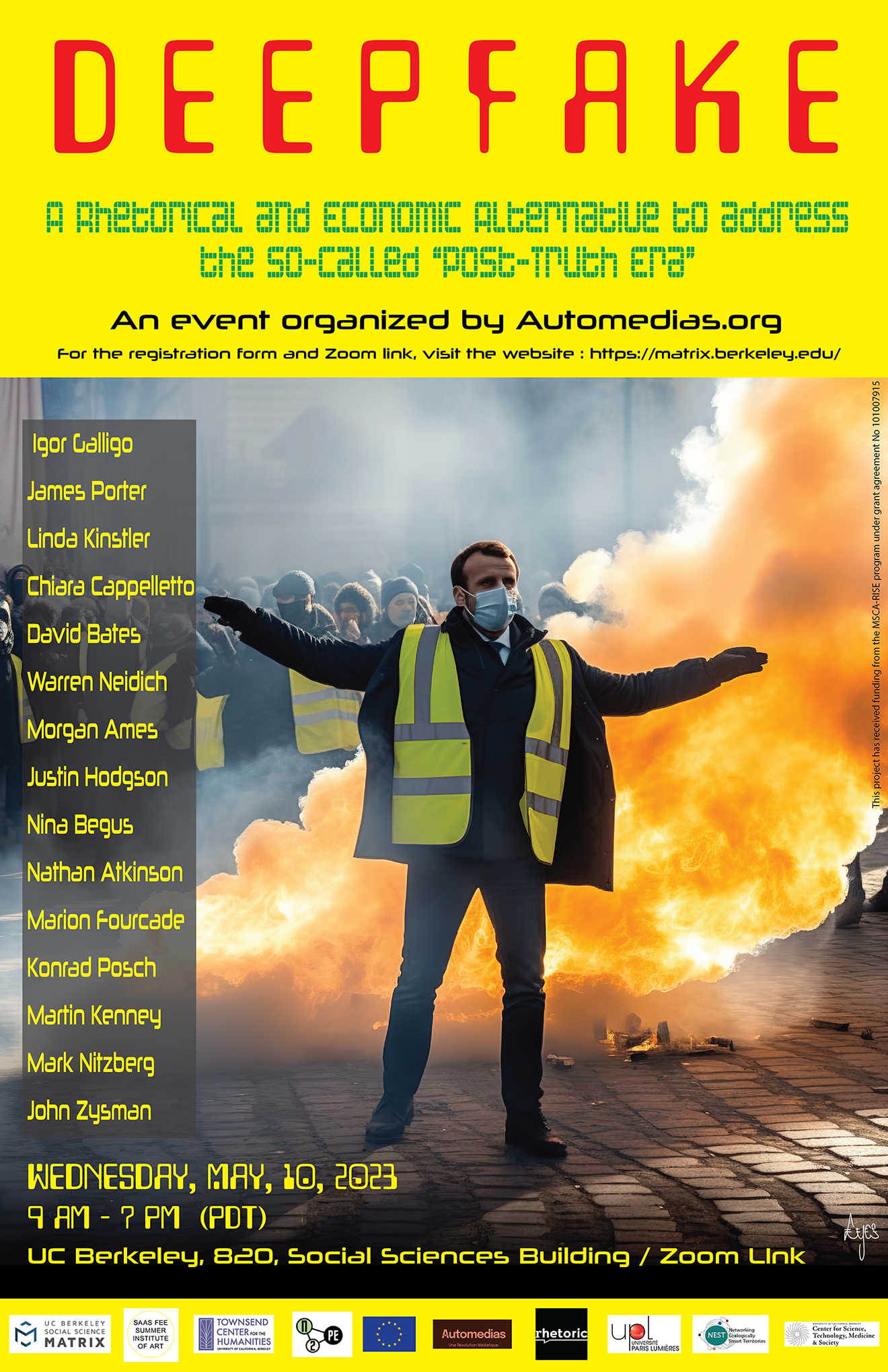
Presentation
Since Greek antiquity, the rhetorical tradition has proposed to conceive and apprehend the search for truth differently from the Western philosophical tradition that was born with Plato. Platonic politics wished to control the city by subjecting political expression to the philosophical concept, whereas rhetoric opposed the logocratic and universal claim of philosophy, in the name of the diversity of subjectivities and forms of life that composed the demos, and justified democratic deliberation as a form and process of agreement and democratic agency.
This symposium aims to develop a critique of the current debates against Post-Truth and fakeness, led today by Big Tech in an effort to ensure its hegemony on the process of subjectivation and to control the political expression of the demos through the control of the digital economy, which today includes the economy of creation and economy of imagination. In addition to the critical force of the rhetoric that we wish to rehabilitate, in order to denounce the illusion of a digital democracy through the current platforms of digital capitalism, this colloquium would like to suggest a different approach to the problems related to the deepfake by proposing an articulation between a Critical Digital Rhetoric and a Digital Political Economy.
Rather than censoring the new combination of Fakeness and Artificial Intelligence, called the deepfake, as Big Tech is doing today, we wish to reintegrate the production of deepfake in a new digital political economy, which would exploit the rhetorical potential of deepfake in a new economy of digital democracy. The latter would face the challenge of revealing the democratic value of the deepfake through the possibility of a circulation and a reappropriation of symbolic images as well as a digital hermeneutic. It is thus a new rhetorical paradigm of digital democracy that we wish to promote as an alternative to the alienating alliance of surveillance capitalism, computational capitalism, computational sciences, and data sciences.
Program
Day 1
Deepfake
Opening
- 9:00 - 9:15opening
By Igor Galligo
- 9:00 - 9:15
Rhetoric, Democracy and “Post-Truth”
How are rhetoric and fakeness consubstantial with democracy? To what conception of truth does the notion of "post-truth" correspond? And why is Post-Truth a problematic notion for the rhetorical tradition?
- 9:20 - 9:45
By James Porter
- 9:50 - 10:15
By Linda Kinstler
- 10:20 - 10:30Discussant
By Chiara Cappelletto
- 10:30 - 10:50
collective discussion with the audience
- 9:20 - 9:45
Break
Subjectivity, Digital Computationalism and Artificial Intelligence
How does the theorization of contemporary computing, which gave birth to the Internet and artificial intelligence, and which is based on computationalism, constitute a problematic conception of subjectivity? How is this conception opposed to the rhetorical and hermeneutic tradition? What conceptions of truth are discarded by computationalism?
- 11:00 - 11:25
By David Bates
- 11:30 - 11:55
By Warren Neidich
- 12:00 - 12:10
By Morgan Ames
- 12:10 - 12:30
collective discussion with the audience
- 11:00 - 11:25
Break
Critical Digital Rhetoric
What renewals can be made within the rhetorical tradition to adapt it to the digital political and Artificial Intelligence contexts? What critical political powers can digital rhetoric retain in the face of computational digital media, fed by data sciences in the new social spaces that are the Internet and social networks?
- 14:00 - 14:25
By Nina Begus
- 14:30 - 14:55
By Justin Hodgson
- 15:00 - 15:10
By Nathan Atkinson
- 15:10 - 15:30
collective discussion with the audience
- 14:00 - 14:25
Break
Computational Capitalism and Surveillance Capitalism in light of the Deepfake
What conceptions and productions of truth do computational capitalism and surveillance capitalism promote? And against what conceptions or practices of producing truth do they discriminate? To which social groups, does this discrimination pose problems of expression and individuation today?
- 15:40 - 16:05
By Marion Fourcade
- 16:10 - 16:35
By Igor Galligo
- 16:40 - 16:50
By Konrad Posch
- 16:50 - 17:10
collective discussion with the audience
- 15:40 - 16:05
Break
For a New Digital Political Economy of Deepfake
How to extend the digital political economy to the symbolic and iconic economy? What new rhetorical and hermeneutic economy of truth can political economy invent? What circuits of collective truth production can political economy develop to grant the deepfake political meaning and value?
- 17:20 - 17:45
By Martin Kenney
- 17:50 - 18:15
By Mark Nitzberg
- 18:20 - 18:30
By John Zysman
- 18:35 - 18:55
collective discussion with the audience
- 17:20 - 17:45
Guests
Chiara Cappelletto
State University of Milan, CSTMS
David Bates
UC Berkeley, Rhetoric Department
David Bates is professor at the Rhetoric Department, of the University of California, Berkeley. He received his PhD in European History from the University of Chicago. Since coming to Berkeley in 1999, he has been working on two main research tracks: one on the history of legal and political ideas, and the other on the relationship between technology, science, and the history of human cognition. He is now completing a book, An Artificial History of Natural Intelligence, that probes the emergence of human thinking as an entanglement of machine technologies, somatic processes, media practices, and social/political organization. Beginning with an examination of Cartesian robotics and early modern reflections on automaticity, he goes on to show how “artificial intelligence” in fact marks a peculiar stage in the history of reason, one that privileges the isolated mind and/or computer. A critique of contemporary models of automatic cognition requires unwinding a certain history of automaticity spawned by this moment, in order to rediscover another, longer history of the “human” constituted within and against technical systems.Igor Galligo
Founder
Université Paris 8, Université de Technologie de Compiègne COSTECH , Université de Leuphana ICAM
Igor Galligo was born in France to families of French, Italian, and Tunisian descent. He received extensive university research education and experience in philosophy, the humanities and social sciences, as well as in art and design, in France (Paris Sorbonne University, Paris 5 University, Paris 8 University, Paris 10 University, EnsadLab, EHESS, ENSAPV, UTC Costech, Ministry of Culture and Communication DREST), Switzerland (IXDM, FHNW), Germany (Technische Universität Berlin; Leuphana Universität Lüneburg), and the United States (University of California, Berkeley). Regardless of the country or university, the research institutions with which he worked suffered from a problem of social representation. Most often, these institutions concentrated creative and production power according to cultures and forms imagined and designed by an elite, rather than according to democratic principles and rules in which other social groups could also find themselves reflected. However, his experiences working within social and cultural associations in working-class neighborhoods have shown him that it is not only possible to democratize the production of knowledge, arts, and technologies, but also urgent to work towards this goal in order to enable the collective construction of societies, beyond the issues of emancipation. To this end, he proposes thinking of democracy and democratization as questions and issues of production, that is to say, as questions pertaining to design, economics, and politics. This is what he is currently working on with Automedias. His aim is to collectively invent and experiment with new contributory designs of information, which must be new ways of informing and communicating in order to reshape the media production of democratic societies.James Porter
UC Berkeley, Rhetoric Department
John Zysman
UC Berkeley, BRIE, CITRIS
Justin Hodgson
Indiana University, Department of English
Konrad Posch
UC Berkeley, Political Science, N2PE
Linda Kinstler
UC Berkeley, Rhetoric Department
Marion Fourcade
UC Berkeley, Social Sciences Matrix, N2PE
Mark Nitzberg
UC Berkeley, BRIE, BCHC, BAIR
Martin Kenney
UC Davis, Department of Human Ecology, BRIE
Morgan Ames
UC Berkeley, School of Information, CSTMS
Nathan Atkinson
UC Berkeley, Rhetoric Department
Nina Begus
UC Berkeley, CSTMS
Warren Neidich
Saas-Fee Summer Institute of Art
Practical info
Joins us
The event will be held at UC Berkeley, in Matrix Conference Room, and online with Zoom.- May 10, 2023, from 9a.m. to 7 p.m.
Matrix Conference Room Please be sure to register Register link University of California, Berkeley 820 Social Sciences Building Berkeley, CA 94720-1922
- May 10, 2023, from 9a.m. to 7 p.m.
Participating online
A Zoom link will be provided after registration. Please be sure to register early. Register link
Organization
Project owners:
- Igor Galligo
Researcher in Media Sciences and founder of the Automedias.org project
Co-organizers:
- David Bates
Professor of Philosophy at UC Berkeley - Marion Fourcade
Professor of Sociology at UC Berkeley - James Porter
Professor of Rhetoric at UC Berkeley - Morgan Ames
Professor of Science of Information and Communication at UC Berkeley
Production Help:
Faith Enemark, Heather Reilly, Davinderjeet Sidhu, Lupita Rodriguez, Eva Y Seto, Julia Sizek, Chuck Kapelke, Oscar Calva, Warren Neidich and Andres Sandoval.
Funding and Scientific Partners
Scientifics Partners of UC Berkeley
Other Scientific Partner




This project has received funding from the MSCA-RISE program under grant agreement No 101007915
Linked publication
- Dessin : Illustration Lyes Hammadouche
- Type : Epilogue, ETC
- Design : bnjm.eu
- Composé, dans un navigateur web, avec PagedJs